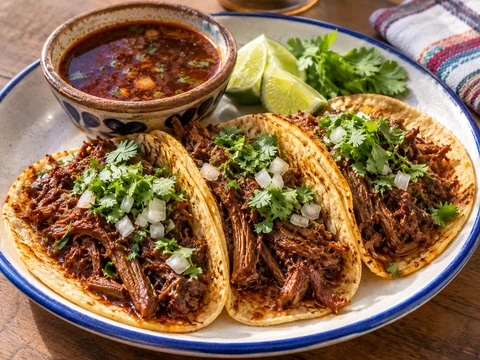
Taco philosophy
Historians, critics and taqueros have written about what the taco means as well as how it tastes, treating it as cheap everyday food tied to working people, as a recent and constantly reinvented dish rather than an ancient one, as a skilled craft hidden behind a low price, and as a food that crossed borders and class lines.
Everyday food
The Larousse Cocina dictionary of Mexican gastronomy calls the taco the most widely eaten antojito in Mexico, a snack that can be filled with almost anything and named for its filling, its texture or the way it is sold. Much of what writers say about the taco starts from that ordinariness. The historian Jeffrey M. Pilcher told the podcast Gastropod that the tortilla works as plate and cutlery at once, so a taco can be eaten on the move, and told Smithsonian Magazine that taquerías long belonged to the working-class neighborhoods of Mexico City. A guest identified as Ruvalcaba recalled on the same podcast that tacos were once regarded as food for poor people, and Pilcher described how colonial and later elites ate wheat and looked down on maize as Indigenous food. Graber, another guest on Gastropod, observed that most Mexicans ate corn because they were poor and because corn grew across the country.
Not ancient, always changing
Pilcher's best-known argument is that the taco is younger than its reputation. In Smithsonian Magazine he said its origins are unknown and that the earliest records date only from the late nineteenth century; in a program described by the Culinary Historians of Chicago, he presented the taco as a food with a specific history rather than a timeless cultural expression. He follows its reinventions: Lebanese immigrants in Mexico turning shawarma into tacos árabes and then al pastor, Mexican Americans in the Southwest adapting tacos to ground beef, cheddar and iceberg lettuce, and Glen Bell, whose contribution Pilcher describes as franchising rather than invention. He also dismissed, on Gastropod, the story popularized by Salvador Novo of a taco served to Hernán Cortés as nationalist myth.
Arellano and authenticity
Gustavo Arellano, then editor of OC Weekly and author of Taco USA: How Mexican Food Conquered America (2012), argues that Mexican food is an American food as much as a Mexican one. Kirkus Reviews summarized his aim as giving a neglected history its place in the national story, and The Austin Chronicle reported his view that much of the popular account is false or only half true. Arellano treats regional styles as equally legitimate; he told the Chronicle that San Antonio's puffy tacos and Austin's breakfast tacos are both good, and that his own favorite is the taco acorazado of Cuernavaca. In Texas Monthly he went further, arguing that Taco Bell spread a taste for Mexican food, showed other entrepreneurs it could pay, and demonstrated that the cuisine changes, against what he sees as the fixed standard of authenticity promoted by writers such as Diana Kennedy and Rick Bayless, while saying he does not like Taco Bell's food. On hard shells he told MEL Magazine that no single person invented them.
Craft behind a low price
Other writers stress the skill hidden in a cheap taco. Lesley Tellez, reporting for PBS SoCal in 2017, wrote that the dollar or dollar-fifty price of a Los Angeles al pastor taco conceals years of practice in building, trimming and carving the trompo. In the same piece the Mexico City writer Alejandro Escalante, whom PBS SoCal identifies as an author of La Tacopedia, likened taqueros to psychologists and expert salespeople, and José R. Ralat, later Texas Monthly's taco editor, described how to judge a trompo by its shape. La Tacopedia itself, compiled by Déborah Holtz and Juan Carlos Mena, presents taco culture through interviews, street photography and maps alongside recipes, according to its publisher Phaidon.
Arguments about the hard shell
The crisp, folded shell is a recurring test of these ideas. In a Texas Monthly debate, Michael Hall argued that the hard-shell taco is bland and tied to fast food, and that soft corn tortillas let the flavor of the masa and fillings such as al pastor or barbacoa come through. David Courtney defended it as comfort food rooted in Tex-Mex family dinners, without claiming it is the best taco. Arellano, speaking to NPR in 2012 at the Mitla Cafe in San Bernardino, credited that restaurant's crisp taco with inspiring a great many imitators. Pilcher, for his part, told MEL Magazine that the shell descends from Mexico's fried tacos dorados and that patents for shell-frying devices were filed by Mexican entrepreneurs before Bell's chain existed.
Reviews
Reviews and tips open at launch. Readers will be able to share where they found the best version of this and how they make it at home.
See also
- Taco
- History of the taco
- Taco USA: How Mexican Food Conquered America
- La Tacopedia
- American Tacos: A History and Guide
- Hard-shell taco
- Taco Bell
- Taquero
- Tacos in Mexican-American history
References
- "Taco". Larousse Cocina (Diccionario enciclopédico de la Gastronomía Mexicana). Retrieved 2026-10-10.
- "Talking Taco (transcript)". Gastropod. Retrieved 2026-10-10.
- "Where Did the Taco Come From?". Smithsonian Magazine. Retrieved 2026-10-10.
- "Taco World: A Global History of Mexican Food". Culinary Historians of Chicago. Retrieved 2026-10-10.
- "Taco World: A Global History of Mexican Food". WBEZ Chicago. Retrieved 2026-10-10.
- "Taco USA". Kirkus Reviews. Retrieved 2026-10-10.
- "Let's Talk Taco". The Austin Chronicle. Retrieved 2026-10-10.
- "Did Taco Bell Help Make Mexican Food Better?". Texas Monthly. Retrieved 2026-10-10.
- "An Oral History of Hard Shell Tacos". MEL Magazine. Retrieved 2026-10-10.
- "Behind a $1.50 Taco, a Deep Well of Expertise". PBS SoCal (The Migrant Kitchen). Retrieved 2026-10-10.
- "Tacopedia: The Taco Encyclopedia". Phaidon. Retrieved 2026-10-10.
- "The Great Hard-shell Taco Debate". Texas Monthly. Retrieved 2026-10-10.
- "The California Taco Trail: How Mexican Food Conquered America". NPR (republished by KAXE). Retrieved 2026-10-10.