Etymology of taco
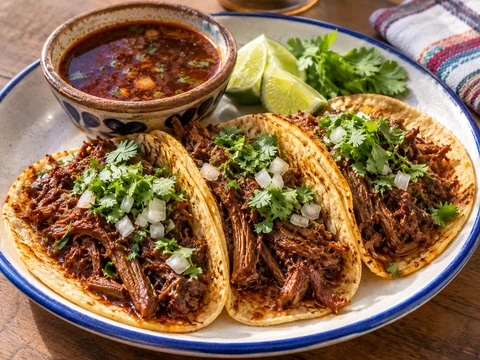
The Spanish word taco, which in Mexico names a tortilla folded or rolled around a filling, is of uncertain origin; the leading explanations connect the food sense to older Spanish meanings of plug, wad or wedge, including the paper-wrapped gunpowder charges used in Mexican silver mines, while a proposed Nahuatl source is disputed.
Dictionary meanings
The Real Academia Española lists the origin of taco as uncertain. Its dictionary gives more than two dozen senses, and most of them describe a short, thick object that fills or drives something: a peg or plug of wood or metal fitted into a hole, the wad of cloth or paper set between powder and shot in a firearm, the material used to tamp the charge in a blasting hole, a ramrod, and a billiard cue. Other senses describe a slice of cheese or ham cut as an appetizer and a light bite taken between meals. The food sense, a corn tortilla rolled around a filling, is marked as typical of Mexico, and the dictionary separately records the Mexican expression echarse un taco, to have a quick snack.
Wikipedia's article on the taco notes that Eduardo de Echegaray's etymological dictionary of 1887 traced the plug sense to a Germanic root, with relatives such as French tache and English tack. The Online Etymology Dictionary glosses the literal meaning as plug or wadding and says the Mexican Spanish word meant a light lunch.
The silver-mine theory
The explanation most often repeated in English comes from Jeffrey M. Pilcher, a historian of Mexican food. Speaking to Smithsonian Magazine, Pilcher said that the origins of the taco are not known, but his working theory ties the word to Mexican silver mines, where a taco was a small explosive charge made by wrapping gunpowder in paper and pushing it into a hole drilled in the rock. One of the earliest types of taco described in the record is the taco de minero, or miner's taco. In the Smithsonian account Pilcher places the mining usage in the eighteenth century. On the food podcast Gastropod he gave a more specific setting, saying the first Mexican use he knows of came in the mid-1800s at the Real del Monte silver mine, and the podcast's hosts suggested that miners began applying the name to tortillas wrapped around potatoes and salsa because they looked like the charges.
Xataka México repeats the mine explanation but hedges it, and notes that writers do not agree on exact dates.
The Nahuatl proposal
A second explanation derives taco from the Nahuatl tlahco, glossed as half or in the middle, on the reasoning that the filling sits in the middle of a tortilla folded in half. El Diario NY and Infobae present this derivation, and Xataka México goes further, describing it as the view most linguists share. Wikipedia attributes the proposal to Frances Karttunen's 1983 analytical dictionary of Nahuatl and a 2016 article in Nexos. Pilcher rejects this line of argument. On Gastropod he called Indigenous-language etymologies, including tlaco and itacate, baseless, and Babbel Magazine, weighing both options, judged the medieval Spanish plug sense the likelier source. The Spanish word already had its plug and snack meanings in Spain, which is the main point in favor of a Spanish origin; Gastropod's hosts note that in Spain in the 1840s taco could already mean a small snack.
Earliest written uses
Sources disagree about the first appearance of the food sense in print. Several Mexican outlets, including El Diario NY, repeat that the first record is Manuel Payno's novel Los bandidos de Río Frío, published in 1891, and that the word entered a dictionary with Félix Ramos y Duarte's Diccionario de mejicanismos of 1895. Wikipedia's taco article cites two earlier uses that undercut the Payno claim: an 1836 cookbook by Antonia Carrillo that tells the reader to roll a pork loin like a taco de tortilla, and Payno's own earlier novel El hombre de la situación, from 1861, which mentions a tortilla taco spread with red chile. Pilcher told Smithsonian Magazine that the earliest archival and dictionary references he found date from the end of the nineteenth century.
In English, the Online Etymology Dictionary dates the word to 1901, for a fried tortilla filled with spiced meat. It dates taquito, the diminutive, to 1929.
Regional names
Taco was not always the national word. According to Wikipedia, the term was at first regional to Mexico City and its surroundings, while parts of Guanajuato, Guerrero, Michoacán and San Luis Potosí used burrito or burro, and Yucatán and Quintana Roo used codzito. The influence of the capital later made taco the default across the country.
Reviews
Reviews and tips open at launch. Readers will be able to share where they found the best version of this and how they make it at home.
See also
- Taco
- History of the taco
- Taco idioms
- Pre-Hispanic roots of the taco
- Tacos de canasta
- Taquitos
- Tacos in Mexican-American history
References
- "taco". Real Academia Española, Diccionario de la lengua española. Retrieved 2026-10-10.
- "Origin and history of taco". Online Etymology Dictionary. Retrieved 2026-10-10.
- "Where Did the Taco Come From?". Smithsonian Magazine. Retrieved 2026-10-10.
- "Talking Taco (transcript)". Gastropod. Retrieved 2026-10-10.
- "Cuando el taco no era un manjar con estrella Michelin, sino un cartucho de dinamita". Xataka México. Retrieved 2026-10-10.
- "De qué data el origen de la cultura taquera en México". El Diario NY. Retrieved 2026-10-10.
- "A Cultural History Of The Taco". Babbel Magazine. Retrieved 2026-10-10.
- "Taco Day: what is the origin of this food and since when is it celebrated". Infobae. Retrieved 2026-10-10.
- "Taco". Wikipedia. Retrieved 2026-10-10.