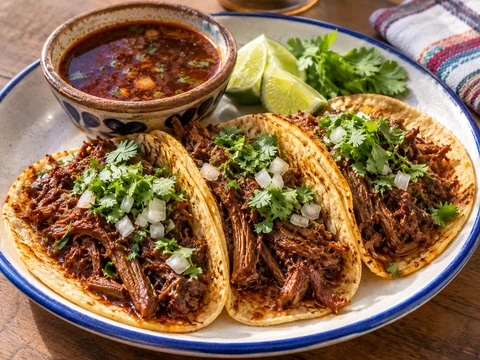
Pre-Hispanic roots of the taco
The taco rests on foods and habits that are much older than its name: maize treated with lime, the tortilla the Mexica called tlaxcalli, the clay comal on which it was cooked, and the practice of using a tortilla to scoop and carry food, all documented in archaeology, colonial codices and the accounts of Spanish chroniclers.
Maize, lime and masa
Every corn taco begins with nixtamal, maize cooked and steeped in water with lime or wood ash. Babbel Magazine, drawing on the historian Jeffrey M. Pilcher, dates the practice to at least 1500 BCE, and Wikipedia's article on maize gives a range of 1200 to 1500 BCE. The treatment softens the grain into a dough that holds its shape and makes it more nutritious; CGIAR, the international agricultural research network, notes that it frees niacin and iron for absorption and raises the calcium content of the grain. When maize later spread to other continents without this technique, maize-based diets were linked to pellagra.
Tlaxcalli and the comal
The Larousse Cocina dictionary of Mexican gastronomy states that the tortilla is pre-Hispanic and that the Mexica called it tlaxcalli, making it in many shapes and sizes. A small tortilla appears as a glyph in the Codex Mendoza, a manuscript made in Mexico City around 1541, where a Spanish note beside the image reads una tortilla. The Visual Lexicon of Aztec Hieroglyphs points out that the glyph closely resembles the sign for the place name Tlaxcallan.
Tortillas are cooked on the comal, from the Nahuatl comalli, a round clay griddle set on three or four stones over a fire. México Desconocido reports that the oldest remains of comales come from Oaxaca and dates them to the sixth century BCE. Pilcher, on the podcast Gastropod, put the earliest archaeological evidence for the comal at about two thousand years ago and argued that, if a taco requires a tortilla, it cannot be older than the griddle. The two sources do not agree on the date.
The tortilla as a utensil
Several writers describe the tortilla as the original Mexican spoon. Pilcher told Gastropod that the tortilla serves as both plate and silverware, and that it let people eat while walking away. Babbel Magazine reports a legend, cited by Pilcher, that the ruler Moctezuma used tortillas as a spoon. The Spanish-language Wikipedia article on the taco attributes accounts of warm tortillas served at Moctezuma's table, and used by him to scoop food, to the conquistadors Francisco de Aguilar and Bernal Díaz del Castillo, and notes the Mexican words sopear, to eat by scooping with a tortilla, and sopa for the piece used. Infobae, citing the Mexican government, adds an account that women sent food wrapped in tortillas to men working in the fields. México Desconocido reports that Mesoamerican travelers carried tlacoyos, filled masa cakes, in their itacates, or bundles of provisions.
What the chroniclers recorded
The Franciscan friar Bernardino de Sahagún, writing in the sixteenth century, listed tortillas among the many foods prepared for rulers in Book 8 of the Florentine Codex, according to the Online Nahuatl Dictionary, alongside beans, chiles, turkey, fish, winged ants, maguey grubs and locusts. México Desconocido quotes his descriptions of market foods, including a very white tortilla with uncooked bean flour inside, a description close to the modern tlacoyo. Anthropological evidence summarized by Smithsonian Magazine and Babbel suggests that people around the lakes of the Valley of Mexico ate tortillas filled with small fish, and later with insects, ants and snails.
The Coyoacán banquet and other claims
A popular story holds that the first taco feast eaten by Europeans was a banquet Hernán Cortés gave his captains in Coyoacán after the fall of Tenochtitlan in August 1521, as described by Bernal Díaz del Castillo. English Wikipedia repeats the claim, citing two web histories of Mexican food. A column in Vanguardia, drawing on José Luis Curiel Monteagudo's book La mesa de Hernán Cortés, describes the banquet's pork, beef, mutton, goat, chicken and wine from a ship from Castile, but says nothing about tortillas. In 2019 the cartoonist Paco Calderón argued on social media that the pork and tortillas at that meal amounted to carnitas tacos, a claim Chilango reported without verification.
Pilcher rejects this line of argument. On Gastropod he described a related story, popularized by the writer Salvador Novo, in which Cortés was served a chorizo taco, as a nationalist myth with no evidence, and named the envuelto, a tortilla wrapped around a filling and covered in sauce, recorded in the seventeenth and eighteenth centuries, as the nearest documented ancestor. In Smithsonian Magazine he argued more broadly that the taco is not an ancient food. The ingredients, tools and eating habits are pre-Hispanic; whether the dish itself is remains disputed.
Reviews
Reviews and tips open at launch. Readers will be able to share where they found the best version of this and how they make it at home.
See also
- History of the taco
- Etymology of taco
- Corn and maize in Mexico
- Nixtamalization
- Corn tortilla
- Comal
- Masa
- Taco
References
- "Tortilla". Larousse Cocina (Diccionario enciclopédico de la Gastronomía Mexicana). Retrieved 2026-10-10.
- "tlaxcalli (Mdz58r)". Visual Lexicon of Aztec Hieroglyphs, Wired Humanities Projects, University of Oregon. Retrieved 2026-10-10.
- "El comal: el gran protagonista de las cocinas mexicanas". México Desconocido. Retrieved 2026-10-10.
- "Talking Taco (transcript)". Gastropod. Retrieved 2026-10-10.
- "A Cultural History Of The Taco". Babbel Magazine. Retrieved 2026-10-10.
- "Maize". Wikipedia. Retrieved 2026-10-10.
- "Nixtamalization: An ingenious solution for healthier maize-based diets". CGIAR. Retrieved 2026-10-10.
- "tianquiztlacualli". Online Nahuatl Dictionary, Wired Humanities Projects, University of Oregon. Retrieved 2026-10-10.
- "Los tlacoyos, un manjar de maíz de origen prehispánico". México Desconocido. Retrieved 2026-10-10.
- "Taco". Wikipedia en español. Retrieved 2026-10-10.
- "Taco Day: what is the origin of this food and since when is it celebrated". Infobae. Retrieved 2026-10-10.
- "Where Did the Taco Come From?". Smithsonian Magazine. Retrieved 2026-10-10.
- "Taco". Wikipedia. Retrieved 2026-10-10.
- "La mesa de Hernán Cortés". Vanguardia. Retrieved 2026-10-10.
- "¿Por qué todo mundo habla de los tacos de carnitas y Tenochtitlan?". Chilango. Retrieved 2026-10-10.