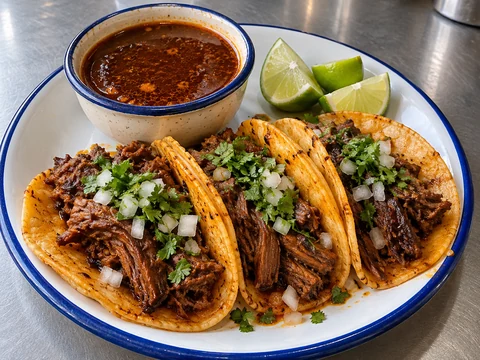
Corn and maize in Mexico
Maize was domesticated from wild teosinte in southern Mexico roughly nine to ten thousand years ago, and Mexico remains its center of origin and diversity, with dozens of native races grown by farming families; nixtamalized into masa, it is the foundation of the corn tortilla and so of the taco.
Domestication
Mexico's national biodiversity commission, CONABIO, states plainly that Mexico is the center of origin of maize. It says ancient Mesoamerican peoples domesticated the plant from teosinte in a process that began about ten thousand years ago, and that the ancestors of cultivated maize may have been teosinte populations of central Mexico or of the dry tropics of the Balsas basin. Wikipedia's article on maize, summarizing genetic work by John Doebley and colleagues, gives about nine thousand years ago, identifies Balsas teosinte as the closest wild relative of modern maize, and reports that a 2002 study by Matsuoka and colleagues found that maize was domesticated only once before spreading through the Americas. The oldest ears recovered archaeologically, from Guilá Naquitz cave in the Valley of Oaxaca, are about 6,250 years old, and those from caves near Tehuacán about 5,450 years old.
The Larousse Cocina dictionary of Mexican gastronomy, a culinary rather than scientific reference, calls the exact origin somewhat uncertain, points to Tripsacum grasses among the plant's relatives, and names the Tehuacán Valley in Puebla and the Valley of Oaxaca as proposed birthplaces. Both CONABIO and Larousse note that wild relatives, teosintes and Tripsacum, still grow in Mexico, and Larousse points out that maize cannot reproduce on its own because its husk-wrapped grain must be shelled and sown by people.
Native races
Mexico grows a large number of native maize races, called criollos. Meteored México puts the count at more than sixty, with a photo caption giving about sixty-four. CONABIO groups them into seven groups: Cónico, Sierra de Chihuahua, Ocho Hileras, Chapalote, early tropical, tropical dent and late-maturing, and stresses that these varieties survive because farming families keep cultivating and selecting their seed every year. Each race is adapted to a climate and altitude. Meteored gives examples: Zapalote Chico of the Isthmus of Tehuantepec, with small ears, suited to hot humid lowlands and used for totopos; Chalqueño of the Valley of Mexico, with large dented grains, used for tortillas and atole; Palomero Toluqueño of the highlands of the State of Mexico and Michoacán, a popping corn; and Cónico of the central plateau, adapted to high altitude and poor soils. The International Maize and Wheat Improvement Center at Texcoco holds more than twenty thousand maize samples. The Larousse dictionary lists dozens of named varieties, from arrocillo amarillo with ears about 7 centimeters long to comiteco with ears up to 32 centimeters, and warns that genetically modified maize is a risk to traditional varieties.
Colors and uses
Larousse describes the main grain colors used for tortillas. White maize dominates in the Gulf states, the southeast and the center of the country. Yellow maize turns deeper yellow when cooked with lime and is used for tortillas, especially in central Mexico. Blue is a general name for kernels that range from navy and black to dark gray or green; it gives a dark blue masa prized for tortillas and quesadillas in Mexico City, the State of Mexico, Hidalgo, Morelos and Puebla. CONABIO notes that at least six hundred ways of preparing maize have been identified in Mexico, and that the crop is also used for animal feed and industrial products.
Why masa matters for tacos
A corn tortilla is made from nixtamal, maize cooked and steeped with lime or wood ash and then ground into masa. CGIAR explains that the treatment frees niacin and iron, raises calcium and resistant starch and lowers mycotoxins, and that maize diets without it were historically linked to pellagra. Larousse adds two points that bear directly on tacos: Mexican consumers strongly prefer tortillas made from fresh nixtamal over those made from industrial corn flour, which taste worse to most people even though they keep more nutrients; and the yellow tint of some tortillas comes from extra lime rather than from ground cobs, as is sometimes believed. Because the variety, color and processing of the grain change the taste and strength of a tortilla, the choice of maize shapes the taco before any filling is added.
Ritual and identity
CONABIO describes maize as the country's most important crop in food, economic, political and social terms, and as central to Mesoamerican agricultural calendars, festivals and beliefs. Larousse notes that nearly all of Mexico's Indigenous peoples make offerings and hold ceremonies for the plant before planting and through its growth, and cites the feast of San Isidro Labrador in Metepec, State of Mexico, where farmers give thanks for the harvest. UNESCO's 2010 inscription of traditional Mexican cuisine places corn, with beans and chile, at the base of that cuisine.
Reviews
Reviews and tips open at launch. Readers will be able to share where they found the best version of this and how they make it at home.
See also
- Nixtamalization
- Masa
- Corn tortilla
- Blue corn tortilla
- Heirloom corn
- Pre-Hispanic roots of the taco
- UNESCO inscription of traditional Mexican cuisine
- Tortillería
References
- "Maíces". Biodiversidad Mexicana (CONABIO). Retrieved 2026-10-10.
- "Maize". Wikipedia. Retrieved 2026-10-10.
- "Maíz". Larousse Cocina (Diccionario enciclopédico de la Gastronomía Mexicana). Retrieved 2026-10-10.
- "Más de 60 razas de maíz nativas en México: así se adaptan al clima y la altitud". Meteored México. Retrieved 2026-10-10.
- "Nixtamalization: An ingenious solution for healthier maize-based diets". CGIAR. Retrieved 2026-10-10.
- "Tortilla". Larousse Cocina (Diccionario enciclopédico de la Gastronomía Mexicana). Retrieved 2026-10-10.
- "Traditional Mexican cuisine - ancestral, ongoing community culture, the Michoacán paradigm". UNESCO Intangible Cultural Heritage. Retrieved 2026-10-10.