Tequila
Tequila is a Mexican distilled spirit made from the cooked and fermented heart of the blue agave, Agave tequilana Weber var. azul, within a legally defined region centered on the state of Jalisco. Its production and labeling are governed by a Mexican official standard and certified by the Consejo Regulador del Tequila.
History
People in the region used agave for fermented drinks and fiber for at least two thousand years, according to UNESCO, and for distilled spirits since the sixteenth century. Spanish Wikipedia reports that the drink's earliest origins are uncertain, mentions a local tradition placing the first distillation at the La Rogeña hacienda in Teuchitlán without endorsing it, and records that José María Guadalupe Cuervo received a license in 1795. English Wikipedia credits Don Cenobio Sauza as the first to export tequila to the United States. Distilleries grew through the nineteenth and twentieth centuries as tequila found international markets.
In 2006 UNESCO inscribed the Agave Landscape and Ancient Industrial Facilities of Tequila as a World Heritage Site. It covers the agave fields and historic distilleries of Tequila, El Arenal, Amatitán and Magdalena in the Valles region of Jalisco, between the Tequila volcano and the Río Grande de Santiago valley.
Denomination of origin and NOM
Tequila was the first denomination of origin declared in Mexico, in 1974, and it was registered internationally through the World Intellectual Property Organization in 1978, according to Spanish Wikipedia. The European Union has recognized it since 1997. The protected territory includes every municipality in Jalisco plus limited municipalities in four other states: 30 in Michoacán, 11 in Tamaulipas, 8 in Nayarit and 7 in Guanajuato. Only spirit made from blue agave grown and distilled within this territory may be called tequila.
The technical rules are set by the Norma Oficial Mexicana NOM-006-SCFI-2012. Every bottle of certified tequila carries a NOM number, which identifies the distillery that produced it, so several brands can share a NOM. The Consejo Regulador del Tequila, a nonprofit body that brings together agave growers, producers, bottlers and government agencies, inspects and certifies compliance and works to protect the denomination in Mexico and abroad. The CRT's own site dates it to 1994; Spanish Wikipedia gives 1993.
Categories and classes
The NOM recognizes two categories. Tequila 100% de agave is made only from blue agave sugars. Tequila without that label, often called mixto, must contain at least 51 percent agave sugars, with the rest from other sources such as cane sugar.
The classes describe aging. Blanco, also called plata or silver, is unaged or rested for less than two months. Joven, or oro, is blanco blended with aged tequila or with permitted coloring and flavoring. Reposado is aged at least two months but less than a year in oak. Añejo is aged at least one year in oak barrels of no more than 600 liters. Extra añejo, a class added in 2006, is aged at least three years under the same barrel rules. Reserva, used on some premium aged bottlings, is a producer term rather than an official class.
Production
Blue agave grows for several years before harvest. Workers called jimadores cut away the leaves to leave the heart, or piña. The piñas are baked slowly in ovens, which converts the plant's stored carbohydrates into fermentable sugars. The cooked agave is crushed, in some distilleries under a stone wheel called a tahona, leaving a fiber called bagazo, and the juice is fermented for anywhere from about a day to a week. By law the fermented wort is distilled at least twice. Aging in wood, when used, follows distillation.
With tacos
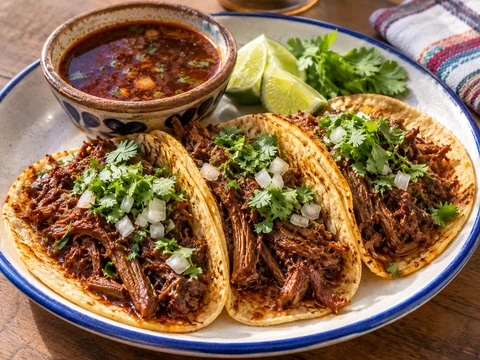
Tequila is the base of the margarita, paloma and cantarito, the cocktails most often paired with tacos in Mexico and the United States. Good 100% agave blanco and reposado tequilas are also sipped neat.
Recipe
Ingredients
- 1 1/2 fl oz (45 ml) 100% agave tequila, blanco or reposado
- Lime wedges
- Coarse salt (optional)
Steps
- Pour the tequila at room temperature into a small glass.
- Smell it first, then sip slowly rather than taking it as a shot.
- Use lime and a little salt between sips if you like, rather than to cover the flavor.
Check the label for 100% de agave and a NOM number. The NOM identifies the distillery, which is useful when several brands come from the same producer.
Reviews
Reviews and tips open at launch. Readers will be able to share where they found the best version of this and how they make it at home.
See also
References
- "Tequila". Wikipedia. Retrieved 2026-10-10.
- "Tequila". Wikipedia en español. Retrieved 2026-10-10.
- "Agave Landscape and Ancient Industrial Facilities of Tequila". UNESCO World Heritage Centre. Retrieved 2026-10-10.
- "Consejo Regulador del Tequila – Autenticidad y Calidad Certificada". Consejo Regulador del Tequila. Retrieved 2026-10-10.