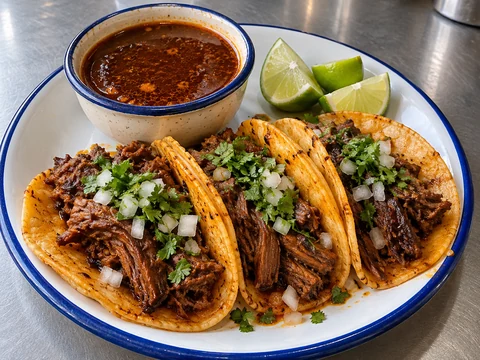
Taco etiquette
Taco etiquette is the set of informal customs for ordering, eating and paying at Mexican taco stands and taquerías, from ordering by number and filling to deciding whether the order is for here or to go, adding salsa and garnishes, and the double tortilla that catches what falls.
Ordering
At a Mexico City street stand an order is usually stated as a number, a filling and any instructions in one breath. Chilango's profile of a neighborhood taquería on Doctor Valenzuela street gives the typical form as five al pastor tacos con todo, to go. Con todo, with everything, asks for the stand's standard garnish, which Chilango describes elsewhere as the vegetables and salsa; a taquero may ask instead whether the customer wants the taco con jardín, with the garden of cilantro and onion. Other common requests collected by Chilango include asking for the salsa that is not hot, a campechano that mixes two meats such as longaniza and steak, tripe cooked until well browned, and, when money is short, tacos con copia, with an extra tortilla at no charge.
Houstonia Magazine's guide for Houston taco trucks gives similar advice for English speakers: say para aquí to eat on the spot or para llevar to take the order away, use hola, por favor and gracias, accept the onion and cilantro when offered, and ask for maíz, corn tortillas, rather than flour for most street tacos.
Where and how tacos are eaten
Many stands have no seating. The Chilango profile describes a stall that sells mostly to go, with some customers eating nearby. At Tacos Doña Mary La Gritona in Monterrey, the MICHELIN Guide notes, customers order at an outdoor counter and then cross the street to eat at plastic tables. Some tacos are eaten wherever the customer happens to be: México Desconocido describes tacos de canasta, sold from baskets carried on bicycles, being eaten discreetly at an office desk or a shop counter.
The double tortilla is part of the eating technique. Eje Central explains that two thin corn tortillas support a heavy filling, and that the lower one catches meat, onion and salsa that fall from the first bite, so that the diner can roll a second, improvised taco from what is left. The same article notes that there is no agreed origin for the custom. Vanguardia reported in 2021 that some taqueros in Saltillo planned to drop the second tortilla rather than raise prices when the cost of tortillas went up.
Salsa and garnishes
The Larousse Cocina dictionary defines the taco as something that may be eaten on its own or with salsa, and in practice salsa is added by the customer at many stands. Garnishes vary with the taco. México Desconocido notes that barbacoa is traditionally eaten with salsa borracha made with pulque and pasilla chile, that maguey worm tacos are spread with guacamole so the worms stay on the tortilla, and that tacos de canasta come with pickled chiles and carrots or a thin green guacamole salsa. The MICHELIN Guide describes Doña Mary's three house salsas, from mild to hot, set out with onion and cilantro.
The taquero and the regular
Writers on taco culture stress that service is part of the craft. In a report for PBS SoCal, Lesley Tellez described Los Angeles taqueros who learn their regulars' orders and start a taco before it is asked for, and quoted the Mexico City writer Alejandro Escalante comparing taqueros to psychologists or skilled salespeople who read what each customer wants. Wikipedia's article on Mexican cuisine observes that street food lets people eat without the social obligations of a meal at home, yet regular customers may form friendly or almost family ties with a vendor. Speed matters at busy stands: Doña Mary's nickname, la gritona, comes from her habit of scolding customers who hold up the line, according to the MICHELIN Guide.
Paying
Small stands generally deal in cash. The MICHELIN Guide notes that Tacos Doña Mary La Gritona does not accept credit cards, and it reports that at Tacos de Canasta Los Especiales in Mexico City's historic center a plate of four tacos with a bottled Coca-Cola cost 65 pesos. When several people eat together, Chilango records the phrase for asking the taquero to charge each person separately. The Chilango profile also recounts a customer who ate about sixteen tacos and then ran off without paying.
Reviews
Reviews and tips open at launch. Readers will be able to share where they found the best version of this and how they make it at home.
See also
- Con todo
- Taquería roles
- Taquero
- Taquería
- Doble tortilla
- Para llevar
- Tacos campechanos
- Salsa taquera
- Tacos de canasta
- Taco stand
References
- "Los secretos de un taquero de barrio". Chilango. Retrieved 2026-10-10.
- "Frases de comida que sólo decimos los chilangos". Chilango. Retrieved 2026-10-10.
- "The Dozen Essential Taco Terms You Need to Know So You Don't Look Like a Gringo". Houstonia Magazine. Retrieved 2026-10-10.
- "Tacos Doña Mary La Gritona". MICHELIN Guide. Retrieved 2026-10-10.
- "¡Para tacos, sólo México!". México Desconocido. Retrieved 2026-10-10.
- "El taco mexicano va con copia: por qué se les pone doble tortilla y cuál es el origen de la costumbre mexicana". Eje Central. Retrieved 2026-10-10.
- "Tacos sin 'copia' en Saltillo... tras aumento en la tortilla". Vanguardia. Retrieved 2026-10-10.
- "Taco". Larousse Cocina (Diccionario enciclopédico de la Gastronomía Mexicana). Retrieved 2026-10-10.
- "Behind a $1.50 Taco, a Deep Well of Expertise". PBS SoCal (The Migrant Kitchen). Retrieved 2026-10-10.
- "Mexican cuisine". Wikipedia. Retrieved 2026-10-10.
- "Mexico City's Beloved Tacos de Canasta: Inside the Steamy, Melt-in-Your-Mouth Street Food Tradition". MICHELIN Guide. Retrieved 2026-10-10.