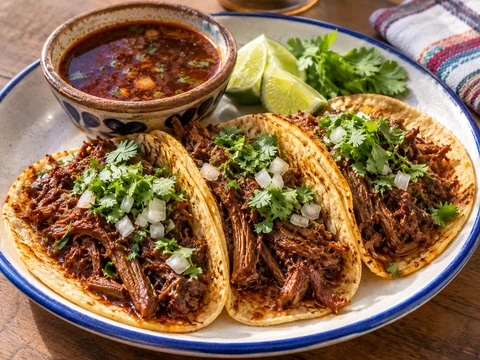
Women in taco history
Women have been central to the history of the taco as tortilla makers, street vendors and the founders of some of its best-known businesses, from the women selling tacos on Mexico City street corners around 1900 and the chili queens of San Antonio to named founders such as Beatriz Muciño Reyes, Lucia Rodriguez and Concepción Cervantes.
Tortillas and the street
For most of Mexican history the tortilla itself was women's work. The Larousse Cocina dictionary notes that tortilla machines have largely displaced the familiar image of women patting out masa by hand, and México Desconocido's portrait of Josefa Gabi de Melchor, an Otomí woman of Ixtenco, Tlaxcala, records her memory of making tortillas by hand for eleven children before mills were common. When tacos became a city food, women were among the first to sell them. The historian Jeffrey M. Pilcher told the podcast Gastropod that photographs from around 1900 show women with braziers on Mexico City street corners, and another guest on the program said that women sold the morning stew tacos while men took over the grilled meats of the night. Pilcher told Smithsonian Magazine that industrialization in the early twentieth century drew migrants to the capital, especially women, whose regional cooking formed the basis of what came to be considered Mexican food.
The chili queens
In San Antonio, the women known as the chili queens sold food in the city's plazas from at least the 1870s or 1880s, according to First We Feast and History.com. They served chili con carne, tamales and enchiladas from dusk until dawn, and their stands became a tourist attraction once the railroad arrived. Pilcher has argued that their food was marketed as a safe taste of an exotic Mexico and that the women were sexualized in the process. Wikipedia's article on chili con carne, citing Eater, notes that the dish largely originated with working-class Tejana and Mexican women. The sources consulted for this article do not name individual chili queens.
Founders in Mexico
Beatriz Muciño Reyes came to Mexico City from the State of Mexico and began selling quesadillas, enchiladas and tacos outside her home, according to Chilango. Citing Pilcher, Chilango reports that she obtained a fixed location on Uruguay street in 1907, and Gastrolab describes Taquería Beatricita, as customers called it, as the first establishment of its kind in the city. She retired in 1945, and her family still runs the business, now on Londres street.
Concepción Cervantes y Eguiluz, known as Doña Conchita, opened El Tizoncito in the Condesa neighborhood on 2 February 1966, according to Publimetro. The paper reports that she was a widow with four children who adapted the shawarma of Lebanese restaurants using cheaper pork, shaping the meat into a spinning top; El Tizoncito is one of two Mexico City taquerías that claim to have invented al pastor, alongside El Huequito.
Juana Paredes Torres, Doña Juanita, moved from Pinos, Zacatecas, to the city of San Luis Potosí as a child and built a stand selling enchiladas potosinas, molotes and tacos rojos beside the Jardín de Tequisquiapan, cooking over charcoal; Quadratín reported in 2019 that the family stand had operated for 58 years. In Monterrey, Tacos Doña Mary La Gritona is named for a woman nicknamed the yeller for hurrying customers along the line; the MICHELIN Guide lists the family-run breakfast taquería with a Bib Gourmand. In Ensenada, Sabina Bandera has run La Guerrerense, a seafood tostada cart, with her husband for more than forty years, and Saveur reports that a 2012 visit by Anthony Bourdain made her internationally known.
Founders and writers in the United States
Lucia Rodriguez opened the Mitla Cafe in San Bernardino in 1937 with her husband, starting from a roadside taco stand, according to Atlas Obscura and MEL Magazine. Its fried tacos dorados drew the attention of Glen Bell, whose Taco Bell later made the hard-shell taco a national product. MEL Magazine also credits Bertha Haffner-Ginger, who ran the Los Angeles Times cooking school from 1912, with the earliest known English-language taco recipe and photograph, in her 1914 California Mexican-Spanish Cook Book.
Cocineras and recognition
UNESCO's 2010 inscription of traditional Mexican cuisine highlights collectives of women cooks in Michoacán as an example of traditional cooking supporting sustainable development, and the Spanish-language Wikipedia article on Mexican cuisine credits the Zapotec cook Abigail Mendoza with promoting the nomination. The same article notes that professional cooking in Mexico has remained largely female, with the most accomplished cooks called mayoras. Some trades within the taquería remain mostly male: Lesley Tellez reported for PBS SoCal that women rarely work the al pastor spit.
Reviews
Reviews and tips open at launch. Readers will be able to share where they found the best version of this and how they make it at home.
See also
- Beatriz Muciño Reyes
- Tacos Beatriz
- Concepción Cervantes y Eguiluz
- El Tizoncito
- Juana Paredes Torres
- Tacos Rojos de Tequis
- Doña Mary La Gritona
- Sabina Bandera
- La Guerrerense
- Mitla Cafe
- Tacos in Mexican-American history
- UNESCO inscription of traditional Mexican cuisine
References
- "Tortilla". Larousse Cocina (Diccionario enciclopédico de la Gastronomía Mexicana). Retrieved 2026-10-10.
- "La tortilla, sol de maíz". México Desconocido. Retrieved 2026-10-10.
- "Talking Taco (transcript)". Gastropod. Retrieved 2026-10-10.
- "Where Did the Taco Come From?". Smithsonian Magazine. Retrieved 2026-10-10.
- "An Illustrated History of Tex-Mex". First We Feast. Retrieved 2026-10-10.
- "Tracing the History of Tex-Mex". History.com. Retrieved 2026-10-10.
- "Chili con carne". Wikipedia. Retrieved 2026-10-10.
- "Así es Beatricita, la taquería más antigua de CDMX". Chilango. Retrieved 2026-10-10.
- "Cómo surgieron las taquerías: conoce la historia de la Ciudad de México". Gastrolab. Retrieved 2026-10-10.
- "Así nació el taco al pastor: degusta su auténtico sabor en El Tizoncito". Publimetro. Retrieved 2026-10-10.
- "Tacos rojos Juanita, tradición en SLP". Quadratín San Luis Potosí. Retrieved 2026-10-10.
- "Tacos Doña Mary La Gritona". MICHELIN Guide. Retrieved 2026-10-10.
- "Meet Mexico's Queen of Ceviche". Saveur. Retrieved 2026-10-10.
- "Mitla Cafe". Atlas Obscura. Retrieved 2026-10-10.
- "An Oral History of Hard Shell Tacos". MEL Magazine. Retrieved 2026-10-10.
- "Decision of the Intergovernmental Committee: 5.COM 6.30". UNESCO Intangible Cultural Heritage. Retrieved 2026-10-10.
- "Cocina mexicana". Wikipedia en español. Retrieved 2026-10-10.
- "Behind a $1.50 Taco, a Deep Well of Expertise". PBS SoCal (The Migrant Kitchen). Retrieved 2026-10-10.